The parishioners of Llangasty must have been more than a little startled when a rather smart young man of 28 appeared out of the blue in 1846 and proceeded to demolish almost all of their crumbling church; and probably equally startled that while he was rebuilding the church he built a school next door, on which he lavished the same high standards of design and craftsmanship as he had bestowed on the church. Considering that there scarcely any children within normal walking distance from the school, they must surely have concluded that young Robert Raikes was not only very rich and very starry eyed, but also very eccentric.
In fact, he was simply ensuring that the children of his future employees and of his neighbours should receive the benefits of a Christian education. This was all part of the Tractarian vision with which he had been smitten at Oxford and which had driven him to take his share out of the family business in Hull and look for a country parish in which he could put his vision of a Christian society into practice.
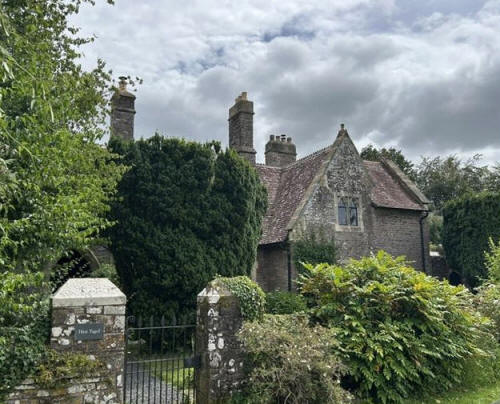
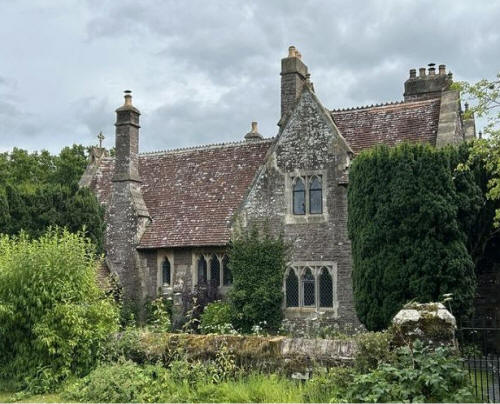
The Architect he chose for this large programme was J L Pearson, later to become one of the pillars of Victorian architecture and designer of Truro Cathedral. The original school was about 20ft by 15ft, built in a similar “Gothic Revival” style to the church, with a huge fireplace, a very high ceiling and a large east window. Not to mention the school bell, which has subsequently welcomed in many New Years and summoned generations of reluctant Raikeses during summer holidays to leave the lake and come home for a meal. The building has been extended many times but the original room is that part of the present house which is nearest to the church.
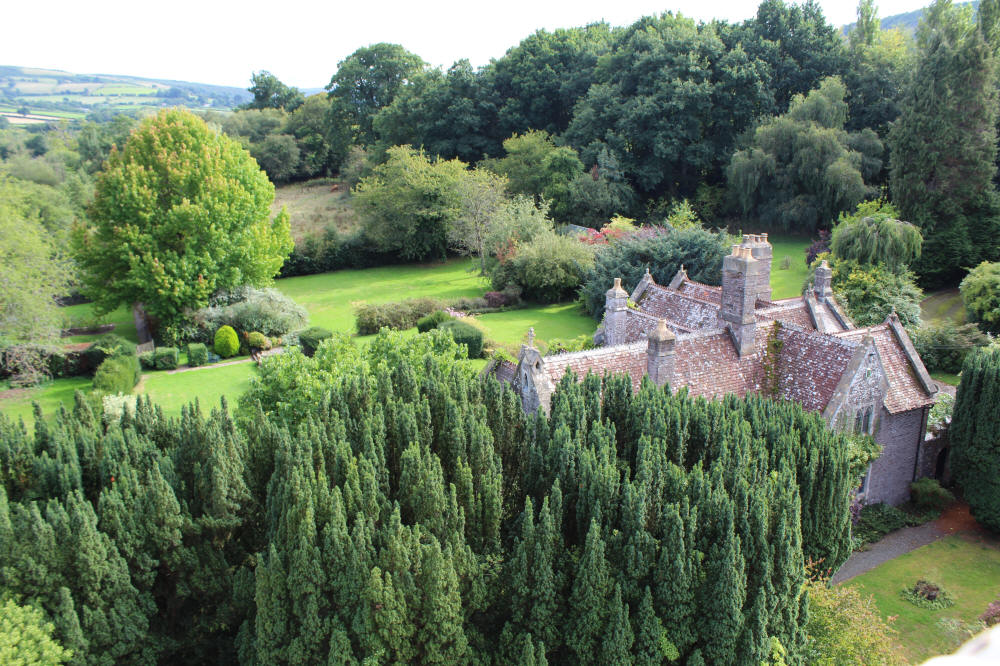
Sadly, but perhaps not surprisingly, Robert’s enthusiasm outran his pocket and very soon after its completion he was obliged to vacate the Treberfydd estate which he let on a long lease to a family of ironmasters from the Valleys 1. We know very little about the school during this period but we do know that the family fortunes revived, because Robert’s son, also a Robert, returned in the 1870s to resume his father’s vision of society.
He soon summoned the faithful Pearson to extend the schoolroom and to add a wing at the western end to accommodate a schoolmaster, and by the end of the century the room was widened to cope with growing demand and separate modern loos were erected on what is now the terrace.
The social upheaval of the First World War, and the death of Robert and his wife, led inevitably to the closure of the school in the mid 1920s. This was followed by a third extension, this time to make the whole building into a more comfortable home for Robert’s two unmarried daughters, Miss Hilda and Miss Dorothy. Miss Dorothy immediately set about making her mark in the area in various ways. She had, for instance, inherited her grandfather’s strong views on religion and for the next 50 years endeavoured to bully a succession of vicars into running the church precisely in accordance with her wishes - and to wage Herculean wars against any bishop who had the temerity to support his vicar. She also more or less single handedly saved the red kite from extinction by roaming over the wilder parts of central Wales with binoculars, a donkey, a tent and a suitcase full of money, with which she induced the startled but impecunious farmers to keep watch over any kite’s nests she could locate. With her restless energy, her crusading spirit and her conviction that she was always right, she may not have been the easiest of people to live with and it is hardly surprising that Miss Hilda decided to migrate to the relative tranquillity of London.
In the 1930s J L earson must have turned in his grave when Miss Dorothy decided to build a fourth extension, to accommodate her staff, in a somewhat idiosyncratic mixture of stone, breeze block, clapboard and roofing felt - but absolutely no insulation. On her death in 1976 we were fortunate to be able to acquire Hen Ysgol and the very beautiful garden she had created, but we discovered that the latest extension posed some other unexpected problems, including a propensity to fill up with water during heavy rain, and to emit vivid blue flashes whenever the lights were switched on. Hence the fact that Hen Ysgol acquired its fifth extension in 1985, when we obtained listed building consent to replace the 1930’s effort with something more in keeping with Pearson. What further changes, I wonder, will the next 150 years bring to the Old Schoolhouse? I am pleased to report that there are still one or two people who remember with apparent affection their schooldays at Llangasty and we hope to be able to record their memories in the near future.
Roger Raikes
1927 - 2018
Hen Ysgol
The family referred to was the Ironaaster Abraham Darby IV who, in 1844 became a major shareholder in the Ebbw Vale ironworks. He lived alongside his works in Ebbw Vale at Victoria Park from 1860 until 1873 until taking the tenancy of Treberfydd.
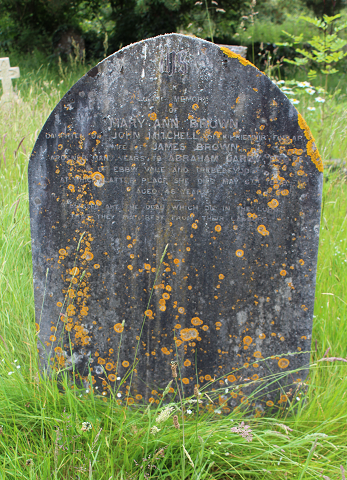
He brought with him his gardener, James Brown. While resident at Treberfydd James Brown’s wife, Mary Ann died. She is buried in the graveyard at St Gastyn’s Church.
The memorial reads: In loving memory of Mary Ann Brown daughter of John Mitchell of Kirriemuir. Forfar wife of James Brown Gardener many years to Abraham Darby of Ebbw Vale and Treberfydd at which place she died May 6th 1879 aged 46 years. Blessed are the dead which die in the Lord that they may rest from their labours
Abraham Darby also died at Treberfydd in November 1878. He had been born into a notable Quaker family but had joined the Church of England and was buried in Coalbrookedale in the Church he had built there.
He brought with him his gardener, James Brown. While resident at Treberfydd James Brown’s wife, Mary Ann died. She is buried in the graveyard at St Gastyn’s Church.
The memorial reads: In loving memory of Mary Ann Brown daughter of John Mitchell of Kirriemuir. Forfar wife of James Brown Gardener many years to Abraham Darby of Ebbw Vale and Treberfydd at which place she died May 6th 1879 aged 46 years. Blessed are the dead which die in the Lord that they may rest from their labours
Abraham Darby also died at Treberfydd in November 1878. He had been born into a notable Quaker family but had joined the Church of England and was buried in Coalbrookedale in the Church he had built there.